Session
Date
Read & Study Sections
Discussion Topics
HW problems/Journal entries
Other Info
May 5, 10 AM - 12:30 PM
Turn in your journal at exam time.
11.5
Both Newton and Leibniz understood and applied the inverse relationship between differentiation and integration, that is, they were familiar with the Fundamental Theorem of Calculus. Both discovered essentially the same rules and procedures of today's calculus: determine maxima and minima, draw tangent lines, find curvature of a curve, determine arc length, substitution method and integration by parts. But they differed in their approaches: Newton through the ideas of velocity and distance; Leibniz through ideas of differences and sums. Also Leibniz's notation and method of differentials was easier to work with and this helped analysis (advanced calculus) progress faster on the European continent. Read about the controversy between Newton and Leibniz on page 323.
11.2.1
11.2.2
11.2.3
11.2.4
11.2.5
11.3.2
11.3.3
Page 326 # 36, 42
11.4.1
In modern calculus, to find the extrema of a function we learn to solve f '(x)=0 that is we find the points that have horizontal tangent lines. Fermat's solution for the maximum product of f(x)=bx-x2 agrees with our modern solution but his reasoning is very different.
# 13, page 253, hint:
(# earls) = (# dukes)(# of earls per duke) = (D dukes) (2D earls per duke) = 2D2 ....
Page 325 # 22, 23, 24
10.3
10.4
.bmp) stands for the kth
entry in the nth row. Pascal found many patterns among the numbers in
the table and these are identities when expressed using the combination
notation. He also laid the foundation for the theory of probability. Newton
generalized the binomial theorem and binomial coefficients to noninteger
values of k. From the time of Euclid, perfect numbers were
known to be related to what are now called Mersenne primes, primes
that can be written in the form 2p-1 where p is
prime. Note that 211-1
=2047=23*89. Fermat proved that if n is
not prime, then 2n-1 is not prime. Fermat's Little Theorem
is an important result in number theory.
stands for the kth
entry in the nth row. Pascal found many patterns among the numbers in
the table and these are identities when expressed using the combination
notation. He also laid the foundation for the theory of probability. Newton
generalized the binomial theorem and binomial coefficients to noninteger
values of k. From the time of Euclid, perfect numbers were
known to be related to what are now called Mersenne primes, primes
that can be written in the form 2p-1 where p is
prime. Note that 211-1
=2047=23*89. Fermat proved that if n is
not prime, then 2n-1 is not prime. Fermat's Little Theorem
is an important result in number theory. 10.1
10.2
9.3.1
10.1.2
10.2
Girard (1595-1632) gave complete relationship between roots of an equation and the coefficients of the equation: coefficients correspond to "factions". Two fathers of analytic geometry are Descartes (1596-1650) and Fermat (1601-1665).
9.1.4
9.1.5
Italian mathematicians were able to solve cubic and quartic equations algebraically. Some of the noted individuals are: del Ferro and Tartaglia (both solved the cubic with no quadratic term); Cardano published the solution to the cubic in his "Ars Magna" in which he also considers negative roots and complex numbers; Bombelli in his "Algebra" contributes to algebraic notation and presents examples of the four arithmetic operations with complex numbers including notion of conjugate for division. The solutions were in the form of rules of procedure; no formulas were written down like the quadratic formula of today. Viete shows how to transform a cubic so it has no quadratic term, wrote 1st book in Western Europe using all 6 trig functions, introduces symbols for constants, replaces search for solutions to equations with theory of equations.
Page 253 # 13, 17, 18, 21
Journal Entry: In the Cardano-Tartaglia formula for solving a cubic equation with no quadratic term, x = a-b. The formula for a was derived in class. Show the steps to find the formula for b.
9.1.2
9.1.3
Levi ben Gerson in his "Art of the Calculator", 1321, uses an inductive style of proof to show how to find the number of permutations and the number of combinations of n objects taken k at a time. In 14th century Italy, the abacists teach the children of middle-class merchants the Hindu-Arabic numeral system and their methods of calculation. About 1450, printing was invented. Regiomantanus (1436-1476) gave Europe 1st study of plane trig independent of astronomy. Frenchman Chuquet introduces Europe to negative numbers, uses positive, negative and 0 exponents. Nicole Oresme (1323 - 1382) makes 1st use of fractional exponents, locates points by coordinates, finds sum of an infinite series. Christoff Rudolff wrote 1st comprehensive German algebra that uses + and - for addition and subtraction, and radical sign. German Michael Stifel (1486-1567) uses symbols of Rudolff, foreshadows invention of logarithms, combines cases of quadratic equation into one, represents unknown with a letter. Robert Recorde (1510-1558) wrote 1st English algebra, uses = for first time.
Page 252 # 1, 8
Journal Entry: Calculate the 20th, 25th and 50th terms of the Fibonacci sequence.
8.1.2
8.3.1
Abraham bar Hiyya: wrote text to help with measurement of fields; used 3 1/7 for pi; measured areas of segments of circles that uses a table of chords (1st time in Europe there appears a trigonometric table).
Leonardo of Pisa (Fibonacci). His greatest work was the Liber abacci; it introduces Hindu-Arabic numerals and the rules for computing with them; it contains many problems that are now standard in algebra texts such as mixture problems, motion problems, container problems, Chinese-remainder problem, problems solvable by quadratic equations and systems of equations, and the rabbit problem (Fibonacci sequence). See pages 202 - 203.
Page 210
# 1, 2, 3, 7, 15
Term paper: Turn in completed term paper by April 14.7.2.4
7.2.5
7.3
7.4
7.5
7.6
There are examples in the book of the inductive type of argument and calculations used by al-Haytham to find the sum of the fourth powers of the first n integers. Al-Karaji also used geometry to prove an identity for the sum of the cubes of the first ten integers. The new Hindu-Arabic numeral system versus the old Roman numerals and abacus method of computation led to a rivalry: the abacist versus the algorist. Al-Baghdadi was able to prove a result on the density property of the irrational numbers. Omar Khayyam was the first to systematically classify and solve all types of cubic equations by the method of intersecting conic sections. Islamic mathematicians also studied combinations, permutations, Pascal’s triangle, the Binomial theorem and amicable numbers. They also used the method of exhaustion to find volumes of solids. While the Hindus developed the sine function, the Arabs added the other five trig functions, and had highly accurate trig tables. They also tried to prove Euclid’s fifth postulate – this eventually was studied in Europe and led to discovery of non-Euclidean geometry.
7.2.4
Al-Samaw'al divided polynomials by polynomials, used negative powers of x if needed, and recognized approximate answers. He was the first to recognize that fractions could be approximated by calculating more and more decimal places through division. [algebraic operations and number operations are parallel]
Islamic mathematicians used inductive arguments to prove formulas about the integers: (1) begin with a value for which the result is known to be true; (2) use the result for a given integer to derive the result for the next integer. They only stated a result for particular integers since they did not have ways of saying the general statement - but it is only a short step for modern readers to go from their arguments to a modern complete inductive proof. Study section 7.2.4.
Term paper: By March 25, submit as complete a draft as possible to the Writing Center for feedback.
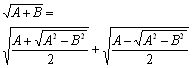
Journal entry: Verify the algebraic identity
7.2.1
7.2.2
7.2.3
Translations and research were done at the House of Wisdom, lasted over 200 years. In his arithmetic text, al-Khwarizmi introduces Indian decimal place value system, shows how to write any number in this notation, describes arithmetic algorithms - his work introduces many Europeans to basics of this numeral system. In his algebra book, al-Khwarizmi uses operation called "al-jabr" to solve equations. He used no symbols, only words, and shifts away from geometric meaning of numbers to find numbers satisfying certain properties. He knew rules for multiplying signed numbers. Al-Samaw'al established the algebra of polynomials: introduced negative coefficients, rules for adding, subtracting, multiplying and dividing polynomials. He used a table for multiplying polynomials.
Page 188
# 4, 5, 6, 9, 11
6.2
6.3
6.4
6.5
7.1
Islamic mathematicians completed the Indian place value system to include decimal fractions, thus creating the modern Hindu-Arabic decimal place value system (Treatise of Arithmetic, 1172).
Early Indian mathematical ideas are found in the Sulbasutras. By 600 CE, the Indians used symbols for 1 through 9 in a place value arrangement - the first to use a decimal place value system for the integers (at first, a dot is used for zero). There is no early evidence that it extends to decimal fractions (tenths, hundredths, etc); these were eventually introduced by the Muslims.
Page 159
# 20 - 23
5.2
5.3
5.4
Pages 134 - 135
# 3, 5, 6, 7
3.3.3
4.3
5.1
(Greek) Ptolemy wrote the Almagest, a work studied, commented upon and extensively criticized, but never replaced for 1400 years, in which he used ideas from plane geometry and spherical geometry and devised ways to perform extensive numerical calculations. The basic element in his trigonometry was the chord subtending a given central angle in a circle of fixed radius, see the formula and figure 3.19 on page 89. He produced a table listing angles and the values of the chords of the angles (equivalent of a sine table).
Hypatia (355-415 CE) is the only Greek woman for which there is substantial indication of math accomplishments. Her death effectively ended the Greek mathematical tradition of Alexandria.
The "oracle bones" are the source of current knowledge of early Chinese number systems, about 1600 BCE. The Chinese used a multiplicative positional decimal numeral system. See pages 117-118.
Page 134 # 1
3.1
3.2
3.3
Practice Exercise
Page 114
# 1
Term paper: By March 3, turn in a preliminary table of contents for your term paper (chapter or section titles).
2.2
2.2.5
Practice Exercises
Page 64
# 19, 25
2.2.6
3.1.1
Term paper: By February 10, turn in 10 references on your term paper topic. At least six of these must be books or articles (give author, title, journal, pages), and at most four may be web sites (give title and URL).
A new attitude toward mathematics appeared in Greece beginning in the 6th century BCE: it was no longer enough to calculate numerical answers; it was necessary to prove the results were correct. Thales is credited with beginning the Greek mathematical tradition. See page 30. Aristotle took the ideas developed over centuries and first codified the principles of logical reasoning; logical argument according to his methods was the only certain way of attaining scientific knowledge. See page 35.
Problems discussed in class: # 4 and 5, page 63; mathematical induction; Pythagorean theorem; sqrt(2) is irrational.
The Pythagoreans were both a religious order and a philosophical school in which "numbers formed the basic organizing principle of the universe... and the basis of all physical phenomena." The Pythagoreans were especially interested in number theory and studied special types of numbers: an amicable pair of numbers, figurate numbers including square numbers, triangular numbers, etc. With their discovery of irrational numbers, they were forced to adjust their mathematical philosophy and this enabled Greeks to develop new theories.
Practice Exercises
Page 63
# 3, 4, 6, 7
3
1.2
Practice Exercises
Pages 26 - 27
# 18, 29
Term paper: Skim through the index of our book and the index of the MacTutor History of Mathematics Archive, http://www-groups.dcs.st-and.ac.uk/~history/ to help you choose possible topics for your term paper. On Feb. 1, turn in two possible topics for your term paper.Journal entry: By Feb 1, complete and include the analysis of your chosen paper in your journal-see the instructions in the class of Jan 18.
2
1.1
Practice Exercises
Pages 25-26
# 2 (and check the answer using the Egyptian method of doubling)
#5
1
1.1
1.1.1 What is the significance of the Rhind Mathematical Papyrus? Of the Moscow Mathematical Papyrus?
1.1.2 Egyptians developed two different number systems: hieroglyphic system and hieratic system. Describe each of these systems.
Go through the database/index for some math journals for a couple of years and make a list of the titles of at least 5 articles that are of interest to you. Turn this list in at the Jan 25 class. Some possible math journals are: American Mathematical Monthly, college Mathematics Journal, Mathematics Magazine, Mathematics Teacher, Historia Mathematica.
Read the abstract of each of the articles on your list. Choose 1 article from the list, print a copy of it and then analyze the article: What is the major topic? What is the time period it covers? Describe the math content. What type references are used? Etc.
MathSciNet (http://www.uhd.edu/library/
subjects/databases.html)
is now available through the UHD library; it is a comprehensive database covering the world's mathematical literature since 1940; the approximately 1800 current serials and journals reviewed in whole or in part are listed in the Abbreviations of Names of Serials; MathSciNet is available 7 days a week. The period between 6 a.m. and 6:30 a.m. U.S. Eastern Time is reserved for maintenance. MathSciNet may be unavailable during this period.